Mga Pahina

Ipinapakita ang mga post na may etiketa na Banknotes. Ipakita ang lahat ng mga post

Biyernes, Oktubre 11, 2013

Compilation of World’s Single Piece High Valued Currency

Over the years, each nation produced their own single piece banknotes in high value. Some nations produced these as non-circulating notes used for internal accounting but some of them are used for payment as well. But some nations like Thailand produced this banknotes for historical events. Here, we compiled a series of World’s Single Piece High Valued Currency and Single Piece Currency in Highest Denomination. 

Hope you enjoyed the list.

10,000 Singapore Dollar note

10,000 Singapore Dollar note
Singapore is one of the two Southeast Asia countries (besides Brunei) that issued the highest value banknote in the world. The highest value means its absolute value which is approximately US$6800 but not its denomination value. Singapore first introduced its $10,000 banknote as the highest denomination of its Orchid series which was issued on 29 January 1973. The note has a dimension of 203 x 133 mm. It is one of the highest value currency in Asia. 

On its subsequent banknotes, the second (Bird) and third (Ship) series, this $10,000 banknote was continued to be introduced in 1980 and 1989. The fourth series of $10,000 banknote was introduced on 9 September 1999. It was designed in gold color with the front features the portrait of Yusof Bin Ishak. The back features the future direction of Singapore economy, one of which is knowledge-based and technology-driven.

£100,000,000 Euro Note

£100,000,000 Euro Note

The Bank of England has non-circulating notes used for internal accounting with a face value of £100,000,000 or $160 Billion Dollars. These high denomination Euro currency notes are said to have been introduced by the Rothschild EuroZone banking cartel to enable suitcase money-laundering, black market liquidity, dark pool financing and élite drug-running operations to keep the major EuroZone banks afloat after the global credit crunch of September 2008.

The particular images above are commemorative versions of the actual notes in circulation. The words "Not legal tender" show on the obverse. And the words "This certificate is backed and secured only by confidence in the European dream" show on the reverse. At the end of June / beginning of July 2012, the European Central Bank tried to cash a €150 billion tranche of this non-commemorative "legal tender" fiat currency for bailout purposes related to Spain. It failed. 


Treasury currency bunkers all over Asia are stuffed full of pallets of shrink-wrapped packages of these high denomination Euro notes. The realisation is dawning in the East, as well as in the West, that these Euros are worthless. They are backed by nothing that is due-diligence tangible in the real-world European economy. They were tendered with fraudulent intent by a rogue faction within the EuroZone banking establishment to sucker Asian creditors.

10,000 BND (Brunei dollar) note

10,000 BND (Brunei dollar) note

It is said that while on a foreign trip to Europe the Sultan of Brunei was asked for identification. Upon this request he produced a banknote showing his face on it.


1,000 Swiss Franc note 

1,000 Swiss Franc note

The 1000 francs from the 8th series of Swiss banknotes, the obverse features the portrait of historian Jacob Burckhardt and the reverse side shows one of the arched windows from the facade of the Swiss National Bank. The portrait on the front side of the 1000 franc note shows Jacob Burckhardt (1818-1897), one of the most distinguished German-speaking historians of culture of the 19th century. He is famous primarily for his well-founded and and artistically sensitive interpretation of the Italian Renaissance and his guide to the art treasures of Italy, a work that has become a classic.

His life work forms the basis for the modern scientific study of art history. His concept of the Renaissance has shaped our understanding of the modern age until today. As a historian, Jacob Burckhardt applied his literary skill to historiography and his work is considered a classic of academic prose.

500 LVL (Latvian lats) 

It was issued during the January 19, 2009 and the note was printed with year 2008.

500 LVL (Latvian lats)

The note depicts the profile of a Latvian folk-maid and a stylised oak-leaf. On the centre-left side of the note, there is a vertical translucent band embedded into the banknote, which covers the see-through register and transparent window above it. Across the top of the banknote, there is the two-colour inscription LATVIJAS BANKAS NAUDAS ZĪME (banknote of the Bank of Latvia), with the serial number of the banknote inscribed in red underneath. Across the bottom of the banknote, there are the inscriptions PIECSIMT LATU (five hundred lats) in the colour changing optical effect print, LATVIJAS BANKA (Bank of Latvia), facsimile signature of the Governor of the Bank of Latvia, and serial number of the banknote in black print. On the right side of the banknote, there is a vertical ornamental band composed of the motif of Lielvārde belt and topped by the numeral 500. When the banknote is tilted to the light, the nominal value is visible on the band. 


While the back depicts a motif of the ornaments of a bronze head-dress. A vertical metallic band on the banknote, a broader holographic clear text window thread with the lettering of the nominal value) is worked into the paper to the left of the centre of the banknote, and a stylised oak-leaf (a see-through register) is to the right. Across the top of the banknote, there is the inscription PIECSIMT LATU (five hundred lats) and numeral 500. The numeral 500 and two-colour inscription LATVIJAS BANKAS NAUDAS ZĪME (banknote of the Bank of Latvia) are at the bottom of the banknote. 


A vertical band of numerals 500 with diagonal stripes that blend into one another is to the left of the ornamental motif. Along the edge of the band, there is the inscription © LATVIJAS BANKA 1992 (© Bank of Latvia 1992) on a white background. The large coat of arms of the Republic of Latvia, with the year 1992 or 2008 inscribed underneath, is depicted on a white background in the lower right corner of the banknote. Above the coat of arms, the paper is watermarked.


Single Piece Currency in Highest Denomination

American $100,000 bill 

American $100,000 bill

The note featured a portrait of Woodrow Wilson which according to the Treasury Department only 42,000 of which were printed during their Dec. 18, 1934, through Jan. 9, 1935 run. But the certificates were never in public circulation the Treasury Department issued them solely to Federal Reserve Banks, which used them only for transactions with one another. This practice continued until the early 1960s, when the government destroyed all but a few, which are now held by the Federal Reserve Bank of San Francisco, the Bureau of Engraving and Printing and the Smithsonian Institute.

500,000THB (Thailand Baht)


500,000THB (Thailand Baht)500,000THB (Thailand Baht)

In 2000, the Bank of Thailand issued 1,998 500,000THB notes to celebrate the 50th anniversary of King Bhumibol and Queen Sirikit. The notes are meant for collectors, but it is still a valid mean of payment. 500,000THB=$15,000.


Sources:
http://lunaticg.blogspot.com/2011/05/world-most-expensive-banknote.html
http://wiki.answers.com/Q/What_is_the_world's_most_expensive_banknote
http://banknoteasia.blogspot.com/2009/01/singapore-10000-highest-value-banknote.html
http://www.livescience.com/32758-which-single-piece-of-currency-is-worth-the-most.html
http://www.banknotes.com/eumil.htm
http://nesaranews.blogspot.com/2012/07/one-million-euro-note.html
http://paperkraft.blogspot.com/2011/03/swiss-banknote-papercraft-chf-1000.html
http://www.snb.ch/en/iabout/cash/current/design/id/cash_current_design_1000
http://www.siambanknote.com/museum/Thai-commemorative-banknotes/50wedding500000.htm
http://hybridbanknotes.blogspot.com/2011/02/latvia-500-lats-2008.html
http://money.uk.msn.com/worlds-most-valuable-banknotes?page=5

Compilation of Famous Banknote Collectors

When banknotes were first introduced, they were, in effect, a promise to pay the bearer in coins, but gradually became a substitute for the coins and a form of money in their own right. For some banknote collecting is a expensive hobby but for some they collect banknotes because they want to share information and unravel the history of each nation. Indeed, banknote collecting is a fascinating and often very lucrative hobby shared by millions around the globe.

Rezwan Razack

Rezwan Razack

Biggest Indian Paper Money Collector
Primary Author of The revised standard reference guide to Indian Paper Money

He is the Chairman of the International Banknotes Society - India Banknote Collector's Chapter. Born in Bangalore, Rezwan Razack, the second son of Razack Sattar grew up in Bangalore where his father handled the family retail business. 

Rezwan attended the prestigious St. Joseph’s College of Commerce. As a student, he won many laurels both academically and in extracurricular activities. Graduating with a degree in Commerce with a fifth rank in the State, Rezwan entered the family retailing business. Rezwan dabbled in Real Estate trading and diversified into Property Development in Bangalore in 1985.

Better known as the Managing Director of the Prestige Group, one of South India’s leading Property Developers, Rezwan Razack is also India's Biggest Collector of Indian Banknotes. Rezwan is the paradigm of an unassuming bureaucrat in the business realm. Having over thirty years of business development experience, Rezwan now handles all construction and engineering activities in the Prestige Group. He has built a highly motivated contracting and engineering team, creating an atmosphere for people to effectively execute their assignments.

Rezwan is very passionate about Indian Paper Money and his collection as a specialist hobby. He possesses one note of every variety of paper money pertaining to India since its inception till date. His collection was built over a period of 40 years, coupled with in-depth research, study and learning on this subject. As a result of this Research on Indian Paper Money, Rezwan co-authored ‘The Revised Standard Reference Guide to Indian Paper Money’. This book was released in January 2012.

Currently Rezwan is the Chairman of International Bank Note Society - India Banknote Collectors’ Chapter. Rezwan was awarded the 2010 Achievement Award by the International Bank Note Society for significant contribution to The Advancement of Numismatic Knowledge by his article 'Banknotes of Portuguese India'. Rezwan also won the Fred Philipson Award for the best article in IBNS Journal 2010.

Kishore Jhunjhunwalla

Kishore Jhunjhunwalla

Collector of Republic India banknotes, Co-Author of The revised standard reference guide to Indian Paper Money. He is also the Author of The standard reference guide to Indian paper money by Kishore Jhunjhunwalla (2000)


Kishore Jhunjhuwalla was born in Bombay on 13th January 1944 into an Agarwal business family from Rajasthan. His father was a first generation businessman, and Kishore joined him soon after attending his Inter-Science level from the University of Bombay in 1962. He spent his career in the family business of rubber and rubber products up to 1997.
Kishore has been collecting banknotes since 1957. The seeds of his hobby were planted within him when one of his relatives gave him a One Rupee note, dated 1935 and bearing the portrait of King George V by detaching it from its booklet! Unlike many others, his enthusiasm in collecting did not wane as he grew up; it grew everyday over the years. The outcome was the finest collection of Indian banknotes ever put together in the world.

While collecting, he felt a vacuum of information. There was no single reference work or catalog of Indian paper money which he could utilize to compare his collection. In order that future generations of collectors should not face such deprivation, he decided it was time to turn to the academics of the subject and venture into publishing such a book. 

The result was his book, 'The Standard Reference Guide to Indian Paper Money', published by Currencies and Coins, Kishore's own publication company. It was released on 22nd April, 2000 in Mumbai's magnificent Town Hall building – the very one seen in a vignette on the notes of Bank of Bombay. The book was pioneering effort, it took eight long years in preparation,and it turned out to be a benchmark in comprehensiveness. 

The book was appreciated world-wide for its in-depth information, presentation, cataloging arrangement and high quality printing. It received the coveted 'Best Book of the Year' award from the International Bank Note Society. In 2005 Mr. Jhunjhunwalla met Mr. Rezwan Razack and found in him the suitable person to carry forward the mantle of collecting as well as researching Indian paper money. The meeting has resulted in the publication of this book.

Mr. Jhunjhunwalla's publications include:
  • Indian Paper Money Since 1950 (1997)
  • The Standard Reference Guide to Indian Paper Money (2000)
  • Paper Money of India, by P.L. Gupta (2000, as publisher)
  • Standard Guide to Indian Paper Money – 1947 to 2010 (2011, as co-author)

Athani Mahalingeswar

Athani Mahalingeswar

Republic Indian paper money, stamps, coins


Octogenarian Athani Mahalingeswar’s antique collections are fascinating. His extensive collection on heritage coins dating from 400 BC to the present, forms merely one part of it. Mahalingeswar is the proud possessor of the first Petromax lamp in history. “It was left by the English at the Chikmagalur headquarters of the Coffee Board’s and I bought it for Rs 50,” he smiles. He also has a beautiful Austrian lamp with majestic carvings, which is over 200 years old and extremely heavy. “It was a gift from an English gentleman, who was the chief of the Bengal-Nagpur Railways in 1955,” he says. His calligraphy collection includes nibs, feathers and ink pots of all ages. The most interesting of them being the ink tablets, which used to be dissolved in water in the olden days. He also has the earliest telegraph, used as a means of communication.

Murali Thantry

Murali Thantry

Collects Indian paper Money, British India Coins

He is a member of Karnataka Numismatic Society and International Bank Note Society. His collecting interest is predominantly British India coinage (1835-1947) and Banknotes of British India, Republic India & Polymer Banknotes.
A native of Moodabidri, in Dakshina Kannada District, Murali Thantry was born in Bangalore, completed his Bachelor's of Commerce from Bangalore University. Murali is currently employed with IBM India Pvt. Ltd., as a Project Manager. 

Murali Thantry's hobbies started with collecting stamps at the age of 10 and over the years built a diverse collection of global coins and banknotes. He finally concentrated on collecting Indian banknotes and coins with prime focus on British India banknotes - a prefix-wise compilation and coins from 1835 to 1947. Murali's Republic India banknote collection mainly consists of notes with exquisite numbers such as 111111, 333333, 555555, etc. Murali Thantry's fascination of collecting Indian banknotes started when his maternal uncle gave him 1000/- to be deposited in the Bank. Murali now has a substantially good collection of British India Banknotes, Coins & Republic India banknotes.

Murali Thantry has participated in many exhibitions conducted by Karnataka Numismatic Society (KNS) and won many prizes in almost all the events he participated in. Murali was the Vice-president for Karnataka Numismatic Society for 4 years and a committee member for 8 years. During these tenure KNS grew phenomenally in terms of revenues and memberships. Murali also regularly delivers lectures on numismatics in the Society's meetings and also actively participates in conducting exhibitions.

Percy Siganporia
Percy Siganporia
Known for his Collection of 10 Rupees from 16 Countries


Percy Siganporia was born and brought up in Bombay (now Mumbai), is the youngest son of Phiroze and Soonoo. Having completed his Bachelor of Science and Computer Management Studies from Bombay University, took up Computer field and served HSBC Bank for more than 2 decades , as Vice President, IT Development. When he was nine his grand-father gifted him a box full of old stamps. 

His serious collection of stamps started only in 1990 when he bought an incomplete collection of King George VI of the British Commonwealth and slowly progressed to almost near completion and had one of the biggest collection of Br. Commonwealth KG VI in Bombay.

Percy started his banknotes hobby by chance, when he happened to pick up a Paper Money Catalogue book of Mr. Manik Jain in early 2000 in one exhibition. He was surprised at the number of Signature varieties and prefixes each denomination had. Since childhood, his favorite number has always been “10”, being a perfect number and in his studies too, he used to excel with 10 out of 10. So he chose ‘10 Rupees’ as his main subject of collection and started Post-Independence prefix-wise.


Sometime in mid-2001, he met Mr. Kishore Jhunjhunwalla in an exhibition and upon receiving his autographed book of IPM, became more involved in this hobby. Mr. Jhunjhunwalla has since been his guide and encouraged him to go even further and excel in this hobby.


While referring the World Paper Money Volumes, Percy realized that 10 Rupees were issued by more than 15 countries , including India and soon embarked upon buying every 10 Rupees which came his way, that too prefix-wise. He now has one of the biggest collections of ‘10 Rupees’ of the world. In 2007 , Percy met Mr. Rezwan Razack who has since been his main source of inspiration and knowledge on the banknotes of India. Percy was also instrumental in the preparation of the Revised Standard Reference Guide to IPM and shared valuable information with the authors.

Percy enjoys travelling to various places in India and abroad. His other interests includes sketching and listening to old movie songs. Currently Percy is the Membership Secretary of IBNS – India Banknote Collectors’ Chapter, IBNS & Life Member of Mumbai Coin Society. Percy is also doing research on the 10 Rupees Unifaces of British India and constantly seeks information on its Dates, Signatories, Prefixes and Issue Circles.

Nilaish Sharma FRNS

Nilaish Sharma FRNS

Collector of World paper money, Indian paper money, specialisation:Presidency Banknotes of India-1770-1861 A.D., and Author of its reference guide, stamps and coins and Proprietor, NILAISH ESQ.

Nilaish Sharma FRNS is a fellow of the Royal Numismatic Society and Co-Founder of Priceless Collectables LLP. He is a dynamic marketing professional with research orientation and equipped with more than 4 years of writing and presenting papers in international mathematical seminars and conferences. His childhood hobby of collecting unique collectibles, is now converted into a passionate of business venture. He has been collecting and researching about Numismatics & Philately of India and world since 1998.

He has been collecting rare banknotes, stamps and coins for past 12 years and had been analyzing, the market growth of collectibles closely in India and abroad. He has also published many articles and books to express the ingenious information about the rarities of these collectibles. He also issue certificates for authenticity for collectibles.

Rajender Maru

Rajender Maru

Collector of Indian Paper Money, Coins, stamps

Rajender Maru has led an active life as a successful businessman and a management wizard.A visionary entrepreneur of distinctive ideas,he had led Maru Group of companies into the premier league. He started his business of Bank notes, Coins and Stamps in the year 1966. He is a master businessman, a highly-motivated and results oriented person with a mission to save historical treasures of worldwide and to spread the awareness of philately & numismatic in upcoming generation.

Dr. Dilip Rajgor (Indian ancient coins and paper money)

Dr. Dilip Rajgor is an archaeologist whose research interests cover a wide spectrum: from prehistoric river Sarasvan to Brahmi script, and early Historic India, palaeolinguistics to numismatics. In all these fields he has published original work.

Dr. Rajgor received his Master's degree in Indian history,culture and archaeology with a Post-Graduate Diploma in linguistics from the M. S. Universe of Baroda (1997). He holds doctorate in Ancient Indian Culture from the University of Bombay (1995).

He has edited two bi-monthly bulletins, viz. Khabamama and ICS Newsletter from 1987-94. Since 1999, he is a member of the Editorial Board of Electronic Journal of Indian Archaeology on the Internet. His published works include Standard Catalogue of Sultanate Coins of India (1991); Studies in the Coinage of the Western Ksatrapas (with Amiteshwar Jha in 1994) and History of the Traikutakas (1998). His forthcoming titles include Numismatic Chronology of Gujarat; Punch-marked Coins of Early Historic India, and History of Gujarat. 

He has contributed fifty-two research articles to various journals and books. He has also participated in various international and national seminars and conferences. He was awarded the "Lowick Memorial Grant" of the Royal Numismatic Society, UK in 1991; and the "Indological Research Fellowship" of the Asiatic Society of Bombay in 1994-95. Dr. Rajgor is also a recipient of the "Prof. H.D. Sankalia Young Archaeologist Award" for the year 1997. At present,, he is working on his multi-disciplinary project, "Rediscovering Palaeo-drainage Network of Sarasvati River in Kachchh (Gujarat)".

Amarbir Singh (Osmania Currency notes, Indian paper money)

Amarbir Singh is an advanced researcher on the banknotes and coins of the Princely State of Hyderabad. He is on the IBNS (International Bank Note Society) panel of experts for Indian Princely States. Amarbir established the India Banknote Collectors' Chapter under the IBNS. He is also a Research Associate with Deccan Heritage Trust. In the book, The Revised Standard Reference Guide to Indian Paper Money by Kishore Jhunjhunwalla, co-authored with Rezwan Razack, he has contributed the chapter on Hyderabad Banknotes (also known as the Osmania Currency banknotes). He stays in Hyderabad (India).

Bazil Shaikh (Indian Paper money collector)

He is a co-author of The Paper & the Promise A Brief History of Currency & Banknotes in India 3rd Revised Edition together with Sandhya Srinivasan. It was published in the year 2009 by Reserve Bank of India Dept. of Currency Management, Museum Cell.

Sources:

http://en.wikicollecting.org/list-of-famous-banknote-collectors
http://www.deccanherald.com/content/19257/passed-down-ages.html
http://www.thehindu.com/todays-paper/tp-national/tp-karnataka/at-80-he-still-craves-for-those-souvenirs/article1359711.ece
http://www.linkedin.com/in/nilaish
http://www.coinnetwork.com/profile/MuraliThantry
http://www.linkedin.com/pub/percy-siganporia/12/645/a94
http://www.indianbanknotes.com/about-ibn/the-team.html
http://www.coinnetwork.com/profile/RajenderMaru
http://collectorssocietypune.com/members.html
http://rajendermaru.com/index.html
http://www.printsasia.com/book/palaeolinguistic-profile-of-brahmi-script-dilip-rajgor-p-g-patel-8177020234-9788177020236
http://en.wikipedia.org/wiki/User:Amarbir_singh/sandbox
http://www.printsasia.com/book/the-paper-and-the-promise-a-brief-history-of-currency-and-banknotes-in-india-bazil-shaikh-sandhya

Lunes, Oktubre 7, 2013

Collection of Banknotes from highest to lowest denomination

banknote is a piece of paper which holds a specific monetary value and is regarded as legal tender in the same manner as a coinSome of these banknotes were produced due to worst inflation crisis and after the World Wars. I hope that you would enjoy the list and if you're looking for a good preserved paper money for your collection you can visit www.papermoneycoincollection.com.

Highest Denominations


Hungary (100 Million B-Pengo)
Front
Hungary (100 Million B-Pengo)
Back

Hungary (100 Million B-Pengo)
The world's highest denomination note is Hungary 100 Million B-Pengo (American 100 Quintillion Pengo)*, issued in 1946. That's 100,000,000,000,000,000,000 Pengo. It was worth about U.S. $0.20 in 1946.


1 Milliard B-Pengo
Front 
1 Milliard B-Pengo
Back

1 Milliard B-Pengo
Hungary also printed a 1 Milliard B-Pengo (Amerian 1 Sextillion Pengo)*, 1,000,000,000,000,000,000,000 Pengo, note in 1946. Overtaken by inflation, it was never in circulation.

* The European number system differs from the American system for denominations above one million:
European 1 milliard = American 1 billion (1,000,000,000)
European 1 billion = American 1 trillion (1,000,000,000,000)

Thus a B-Pengo or 1 Billion Pengo is really American 1 Trillion Pengo.


Germany (100,000,000,000,000 drachmai)


Germany (100,000,000,000,000 drachmai)
Its worst inflation was in 1923, and the highest denomination was 100,000,000,000,000 Mark.


Greece (100 billion drachmai)
Front
Greece (100 billion drachmai)
Back

Greece (100 billion drachmai)
Greece went through its worst inflation in 1944. In 1942, the highest denomination was 50,000 drachmai. By 1944, the highest denomination was 100,000,000,000,000 drachmai.


Zimbabwe (ZWD100 trillion bill)

Zimbabwe (ZWD100 trillion bill)
Zimbabwe started to experience inflation just at the beginning of  21st century. On 5 May 2008 the Reserve Bank of Zimbabwe issued bank notes (or "bearer cheques") of ZWD 100 million and ZWD 250 million. 

On 1 August 2008, the Zimbabwe dollar was re-denominated by removing 10 zeroes and ZWD 10 billion became 1 dollar after the re-denomination. On 16 January 2009, Zimbabwe issued a ZWD100 trillion bill (100,000,000,000,000 ZWD).


500 billion dinar note

Yugoslavia (500 billion dinar note)
On December 23, 1993, the former Yugoslavia issued a new banknote to keep up with rampant inflation, the 500 billion dinar note, that's a 5 followed by 11 zeros, but shortly after cut off nine of the zeros.


Japan ND (1930) 100 Yen


Japan 75,000,000,000 Yen ND (1930)

Japan issued the highest denomination just after world war II, which was a 75,000,000,000 Yen bank cheque.


50,000,000,000 Dinara Krajina
Front
50,000,000,000 Dinara Krajina
Back

Krajina (50,000,000,000 Dinara)
The worst inflation in 1993 in Krajina had forced its central bank to issued the highest denomination at 50,000,000,000 Dinara. This country was reincorporated into Croatia in 1998. Republika Srpska, a country beside Bosnia Herzegovina, also issued a similar bank note of Dinara Krajina.


10,000,000,000 Mark


Free City of Danzig ( 10,000,000,000 Mark)
Danzig was a semi autonomous baltic sea port and city state that was created on 10 January 1920, then the region has incorporated into the Peoples' Republic of Poland. Danzig worst inflation in 1923 and issued the highest denomination of 10,000,000,000 Mark.


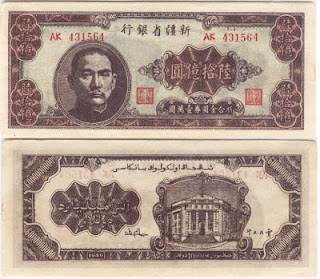
6,000,000,000 Yuan in 1949


China (6,000,000,000 Yuan in 1949)
The Republic of China went through the worst inflation in 1948-49. The highest denomination issued by a regional bank in Xinjiang Provincial was 6,000,000,000 Yuan in 1949.


1,000,000 Dinara


Bosnia Herzegovina (100 million Dinara) 
Bosnia Herzegovina declared independence from Yugoslavia in March 1992 and use the first Dinar that different from Yugoslavia Dinara, in July 1992. The highest denomination was 100 million Dinara.


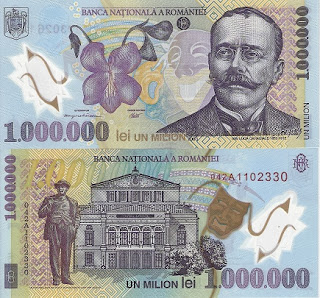
Highest Denomination Polymer Banknote


Romania 1 Million (1,000,000)

Romania 1 Million (1,000,000) Lei, issued in 2003, is the world's highest denomination polymer plastic banknote. It's no longer legal tender. Four zeros were dropped in the 2005 currency reform.


Lowest Denomination

Fiji 1 penny
Fiji 1 penny
The lowest fractional note is Fiji 1 penny, issued in 1942. The old penny, being 1/240 of a pound, is a lower denomination than other fractional notes based on 1/100th of a basic monetary unit.


No Denomination

Tatarstan
Front
Tatarstan
Back
1,000 Rubles, 1995
Issued without denomination

The notes with no denomination - Tatarstan issued a series of currency checks without any denomination printed. 
Tatarstan is situated in the middle of Russia. It was colonized by the Bulgars in the 5th century, conquered by Genghis Khan in the 13th century, and controlled by Russia from 1552 until the dissolution of the Soviet Union. Proclaimed sovereignty and achieved de facto independence 1991-1994. Tatarstan was associated state with Russian Federation on confederate status 1994-2000, and is a subject of Russian Federation since 2000.