Mga Pahina

Martes, Oktubre 8, 2013

The Future of Money – A global currency?

Today, I would like to share with you an infographic you should read. This info infographic presents a valuable information about what is happening between the stock market and foreign exchange crisis.

The editors at Money Choice have been interested in the topic of the future of money in a global economy and decided to do some research. This infographic is the result of their efforts.

The Future of Money – A global currency?

www.MoneyChoice.org

The Future of Money: A Global Currency
Created by MoneyChoice.org

Lunes, Oktubre 7, 2013

Collection of Banknotes from highest to lowest denomination

banknote is a piece of paper which holds a specific monetary value and is regarded as legal tender in the same manner as a coinSome of these banknotes were produced due to worst inflation crisis and after the World Wars. I hope that you would enjoy the list and if you're looking for a good preserved paper money for your collection you can visit www.papermoneycoincollection.com.

Highest Denominations


Hungary (100 Million B-Pengo)
Front
Hungary (100 Million B-Pengo)
Back

Hungary (100 Million B-Pengo)
The world's highest denomination note is Hungary 100 Million B-Pengo (American 100 Quintillion Pengo)*, issued in 1946. That's 100,000,000,000,000,000,000 Pengo. It was worth about U.S. $0.20 in 1946.


1 Milliard B-Pengo
Front 
1 Milliard B-Pengo
Back

1 Milliard B-Pengo
Hungary also printed a 1 Milliard B-Pengo (Amerian 1 Sextillion Pengo)*, 1,000,000,000,000,000,000,000 Pengo, note in 1946. Overtaken by inflation, it was never in circulation.

* The European number system differs from the American system for denominations above one million:
European 1 milliard = American 1 billion (1,000,000,000)
European 1 billion = American 1 trillion (1,000,000,000,000)

Thus a B-Pengo or 1 Billion Pengo is really American 1 Trillion Pengo.


Germany (100,000,000,000,000 drachmai)


Germany (100,000,000,000,000 drachmai)
Its worst inflation was in 1923, and the highest denomination was 100,000,000,000,000 Mark.


Greece (100 billion drachmai)
Front
Greece (100 billion drachmai)
Back

Greece (100 billion drachmai)
Greece went through its worst inflation in 1944. In 1942, the highest denomination was 50,000 drachmai. By 1944, the highest denomination was 100,000,000,000,000 drachmai.


Zimbabwe (ZWD100 trillion bill)

Zimbabwe (ZWD100 trillion bill)
Zimbabwe started to experience inflation just at the beginning of  21st century. On 5 May 2008 the Reserve Bank of Zimbabwe issued bank notes (or "bearer cheques") of ZWD 100 million and ZWD 250 million. 

On 1 August 2008, the Zimbabwe dollar was re-denominated by removing 10 zeroes and ZWD 10 billion became 1 dollar after the re-denomination. On 16 January 2009, Zimbabwe issued a ZWD100 trillion bill (100,000,000,000,000 ZWD).


500 billion dinar note

Yugoslavia (500 billion dinar note)
On December 23, 1993, the former Yugoslavia issued a new banknote to keep up with rampant inflation, the 500 billion dinar note, that's a 5 followed by 11 zeros, but shortly after cut off nine of the zeros.


Japan ND (1930) 100 Yen


Japan 75,000,000,000 Yen ND (1930)

Japan issued the highest denomination just after world war II, which was a 75,000,000,000 Yen bank cheque.


50,000,000,000 Dinara Krajina
Front
50,000,000,000 Dinara Krajina
Back

Krajina (50,000,000,000 Dinara)
The worst inflation in 1993 in Krajina had forced its central bank to issued the highest denomination at 50,000,000,000 Dinara. This country was reincorporated into Croatia in 1998. Republika Srpska, a country beside Bosnia Herzegovina, also issued a similar bank note of Dinara Krajina.


10,000,000,000 Mark


Free City of Danzig ( 10,000,000,000 Mark)
Danzig was a semi autonomous baltic sea port and city state that was created on 10 January 1920, then the region has incorporated into the Peoples' Republic of Poland. Danzig worst inflation in 1923 and issued the highest denomination of 10,000,000,000 Mark.


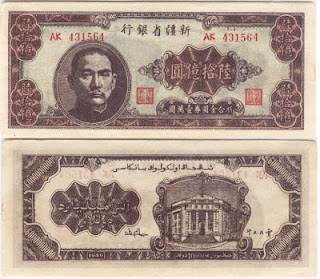
6,000,000,000 Yuan in 1949


China (6,000,000,000 Yuan in 1949)
The Republic of China went through the worst inflation in 1948-49. The highest denomination issued by a regional bank in Xinjiang Provincial was 6,000,000,000 Yuan in 1949.


1,000,000 Dinara


Bosnia Herzegovina (100 million Dinara) 
Bosnia Herzegovina declared independence from Yugoslavia in March 1992 and use the first Dinar that different from Yugoslavia Dinara, in July 1992. The highest denomination was 100 million Dinara.


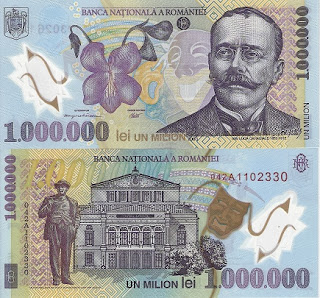
Highest Denomination Polymer Banknote


Romania 1 Million (1,000,000)

Romania 1 Million (1,000,000) Lei, issued in 2003, is the world's highest denomination polymer plastic banknote. It's no longer legal tender. Four zeros were dropped in the 2005 currency reform.


Lowest Denomination

Fiji 1 penny
Fiji 1 penny
The lowest fractional note is Fiji 1 penny, issued in 1942. The old penny, being 1/240 of a pound, is a lower denomination than other fractional notes based on 1/100th of a basic monetary unit.


No Denomination

Tatarstan
Front
Tatarstan
Back
1,000 Rubles, 1995
Issued without denomination

The notes with no denomination - Tatarstan issued a series of currency checks without any denomination printed. 
Tatarstan is situated in the middle of Russia. It was colonized by the Bulgars in the 5th century, conquered by Genghis Khan in the 13th century, and controlled by Russia from 1552 until the dissolution of the Soviet Union. Proclaimed sovereignty and achieved de facto independence 1991-1994. Tatarstan was associated state with Russian Federation on confederate status 1994-2000, and is a subject of Russian Federation since 2000.

Biyernes, Oktubre 4, 2013

J.S.G. Boggs - Famous for paper money Art


J.S.G. Boggs best known for his hand-drawn, one-sided depictions of U.S. banknotes (known as "Boggs notes") and his various "Boggs bills" he draws for use in his performances. Boggs  (born 1955) is an artist who draws paper money, but not for the sake of counterfeiting. Boggs' notes are very high quality and often include subtle humor in their text and portraits.  

Because his subject matter is paper money, Boggs has been very well received by the paper money dealers. In addition to the art, he is notorious for creating thought provoking transactions with his art, offering it for goods/services in lieu of real money. The people who accept this transaction get the better end of the deal. His real message is that money is an abstract concept that can be manipulated in interesting and creative ways.

Boggs was first arrested for counterfeiting in England in 1986, but was successfully defended by the human rights lawyer Geoffrey Robertson QC and acquitted. He was arrested for a second time in Australia in 1989, but also acquitted. Since 1990 some of his work and personal effects have been confiscated by the United States Secret Service Counterfeiting Division although no legal case has been brought against him.

The reason he avoids criminal liability for counterfeiting is that he does not claim his artworks are money; rather he sells his notes. In September 2006, Boggs was arrested in Florida and charged with possession of methamphetamine, possession of drug paraphernalia and carrying a concealed weapon. He failed to appear in court a few months later.

Artist J.S.G. Boggs, shown at a New York gallery in 1987, displays his realistic drawing of a $20 bill, which he bartered for a shipment of lobsters.

Some of his works are below:

An early 2000s Boggs customized $50 note, from the Thomas Jefferson Center.

A 1996 Boggs "Fun" bill, in orange.
A Boggs Fr-100 French Franc note, from Demenga Gallery in Basel, Switzerland.

An early 1990s Boggs $500 note, from the University of Kansas Spencer Museum of Art.
A Boggs CHF-1000 Swiss Franc note, from Demenga Gallery in Basel, Switzerland.

References:

Compilation of Famous Coin Collectors

Coin collecting can be vast as it could be. From Kings and Queens up to famous celebrities, coin collecting is indeed a lucrative hobby to rich and famous but for some can be good source of profitable income.

Throughout history, many famous people from ancient or contemporary periods have been collecting coins. And the coins once they owned nowadays valued for millions of dollars. Indeed, coin collecting is a fascinating and often very lucrative hobby shared by millions around the globe.
Image: (© mahendra ) 

Contemporary coin collecting has its roots in ancient Rome around the 14th century and in the dawn of the Renaissance.
Coin collecting is more than likely began as a hobby for kings and rulers of ancient and wealthy dynasties and history proves that they have put together some astonishing collections. Throughout history, kings and influential families gathered impressive collections and set the standards for what numismatics is today.

  • Although Augustus Caesar, the emperor and founder of the Roman Empire, showed a collection of exotic coins at certain occasions and festivities, there is no real evidence that he was indeed a collector.
  • Francesco Petrarch, who is considered the father of coin collecting, laid the foundation of numismatics and modern coin collecting. Petrarch, as one of the earliest humanists, was an Italian scholar and poet who lived between 1304 and 1374. He is considered to be the first Renaissance collector and the father of numismatics. His passion began when vine diggers began asking him to identify and possibly buy the various coins they found while digging. This is how he began studying coins, by trying to identify the rulers, years, and values. The methods he used back then are very similar to the ones collectors use today. In 1355, he presented a collection of coins to Emperor Charles III, the Holy Roman Emperor, which is the most significant evidence of his collection.
  • The Medici family was one of the most influential and powerful families on the political scene in the 15th and 16th centuries in Florence. Using their wits and merciless tactics, they went from being a simple family of farmers to one of the richest families in Italy. They soon became famous for their exorbitant wealth, prestige, and unsurpassed collections. In the 16th century, the Grand Duke Cosimo I began collecting works of art, armor, and coins. The Medici Dynasty continued to expand its notorious coin collections and added valuable specimens from ancient Rome.
  • Alessandro Farnese, the grandson of Pope Paul III, was an Italian cardinal who lived between 1520 and 1589. He was a great diplomat and one of the greatest collectors and patrons of art. He gathered the largest collection of Roman sculptures and was a patron of living artists of his time. He also collected ancient coins just like his grandfather, Pope Paul III. The Farnese Collection is the most complete collection of artistic items from the Greco-Roman period and includes some of the most valuable ancient coins in the world.
  • King George III of England, deserves a special place among famous coin collectors, as he is the founder of the numismatic section of the Glasgow Museum. He used his own collection, plus that of his personal surgeon, William Hunter, to establish the first ancient coin exhibition in England. The grandson of George II ruled England between 1760 and 1820. His coins are divided in two subgroups, between 1760 and 1815 and between 1816 and 1820. This is a time when the British Empire went through a series of drastic changes, and this is reflected in the coinage of the period. The coins minted under George III have become an attraction for modern collectors.
  • King Victor Emmanuel III ruled Italy between 1900 and 1946. He is considered to be one of the greatest coin collectors in history, having gathered around 100,000 coins. His collection contains specimens from the fall of the Roman Empire up to the Italian Unification in the 19th century. His passion was fueled by his tutor, Edigio Osio, who collected coins as a hobby and saw them as a means of gaining his pupil's attention when teaching history. The young Victor Emmanuel started his own collection, originally comprised of 75 pieces. By the time Osio left, Victor Emmanuel already had 3,000 specimens.
  • French King Louis XIV possessed a collection that he carefully watched over and attended to each and every day.
World leaders are also known to be enthusiastic coin collectors, not the least of which were three of America’s former presidents.
  • John Quincy Adams is reputed to have been one of our country’s most renowned coin collectors during the colonial era. Adams’ face would of course be positioned on the one dollar Presidential Coin in the year 2008.
  • Thomas Jefferson was in possession of a collection that encompassed both ancient and contemporary coins from all over the world.
  • Franklin Delano Roosevelt, the man whose face adorns the dime was also a coin enthusiast, and led the fight to eradicate polio. Because of this effort, his crusade became what is called the March of Dimes in honor of his dedication to the cause.
In the world of sports, there are two notable personalities that were not only icons in the category of their chosen field of expertise, but were also known to the coin collecting arena as well.
  • Wayne Gretzky, called The Great One by his fans, and one of the best athletes in the history of professional hockey, was also a devoted collector of both rare and valuable coins, though with an eye toward monetary rather than historical value. 
  • Andre Dawson, the recent Hall of Fame inductee and world renowned baseball player is also a collector of note. His collection was considered one of the finest, though he recently decided to auction it off for quite a lucrative sum. 
Even a few recognizable names from Hollywood share common admiration for coin collecting. 
  • Buddy Ebsen who played Jed Clampett from the Beverly Hillbillies, shows devotion to his collection certainly proves otherwise.
  • There are also a few unverified rumors concerning Nicole Kidman, one of filmdom’s biggest mega-stars. She is reputed to have a fascination for coins and also in collecting them.
And last but not the least the music industry also claim a coin collecting enthusiast among its members.

Though Paul McCartney is not considered a qualified nor passionate numismatist, his interest is said to have its origins in the early days of the Beatles’ performances on stage. 

When the band was ‘pelted’ with pennies at the close of their shows, they would scoop them all up off the stage, and so began the coin collecting career one of Britain’s most honored musicians and composers.

Collecting continues to grow and fascinate people from every walk of life. Coin collecting not only shares a hobby but also puts everyone who is drawn to its allure and historical significance among very good company indeed.


Resources:


http://www.makethelist.net/ten-famous-coin-collectors/

http://coins.thefuntimesguide.com/2010/05/coin_collectors.php
http://blog.coinsupplyplanet.com/famous-coin-collectors-then-and-now/
http://coincollecting.answers.com/history/the-most-famous-coin-collectors-of-all-time